
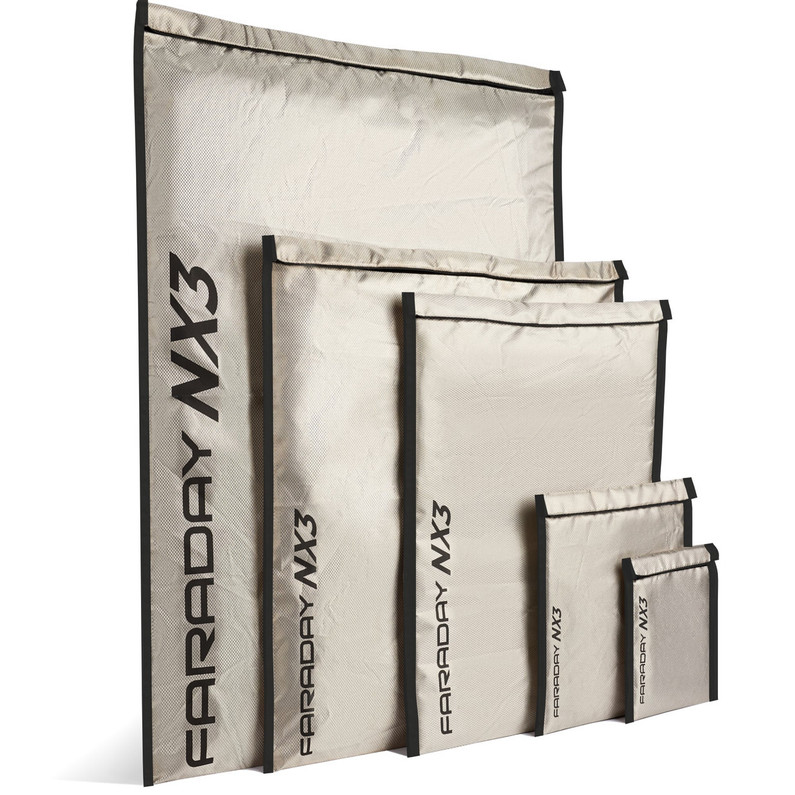
Faraday Bags: How They Work and How the Certifications Differ
Image: Faraday Defense
Product help guide
A Faraday bag is a simple idea: a pouch lined with conductive fabric that stops wireless signals from reaching the device inside. People use them to keep a key fob quiet overnight, take a phone offline for a while, store spare electronics or travel with a laptop that shouldn't be reachable. This guide covers how they work, what they can and can't do, how to test one at home, which size fits your device, and what the numbers and standards on the label actually mean.
How a Faraday bag works
Phones, key fobs, Wi-Fi, Bluetooth, GPS and RFID cards all talk using radio waves. A conductive layer reflects and absorbs that radio energy instead of letting it pass through. In the Faraday Defense bags we carry, that layer is metal-plated nickel/copper fabric (CYBER NC), and the signal-blocking bags use three layers of it. As CAA North & East Ontario puts it, the metal "provides a barrier that interrupts radio signals to and from the smart fob." [1]
Two things matter most:
- The enclosure has to be complete. Signals get through gaps, so the closure is part of the shield. NX3 bags use a double-roll hook-and-loop closure, JACKET bags a double-fold closure, and JACKET Pro bags a magnetic double-fold closure. Close yours exactly the way the listing describes.
- Condition counts. Tears, worn seams and a closure that no longer lines up all let signal in. Check your bag now and then, and retest it (see below).
What it does and doesn't protect against
Phones. Our NX3 and JACKET listings say these bags block cellular (including 5G), Wi-Fi, Bluetooth, GPS and RFID. While the phone is sealed in the bag it can't ring, receive messages or share its location. It still works, and it reconnects as soon as you take it out, so anything waiting arrives then.
Key fobs and relay theft. Keyless cars talk to the fob with low-power radio that only works within about a metre. Thieves use equipment to relay that signal from a fob inside your house to the car in the driveway. [1] Toronto Police 31 Division and Toronto Crime Stoppers encourage drivers to put fobs in signal-blocking or Faraday pouches instead of hanging them by the front door. [2] Équité Association lists a Faraday pouch as one layer of a layered approach, alongside steering wheel locks, OBD port locks, immobilizers and tracking. [3] So a pouch helps, but it isn't the whole plan. And don't use the freezer or microwave instead. CAA warns these can damage the fob. [1]
RFID cards. Bank and access cards can go in the key fob bag (its listing says it also fits credit cards) or in an RFID-blocking wallet.
What a bag won't do:
- It can't protect a device that's out of the bag or in use.
- It can't remove malware that's already on a device, or protect accounts and data stored in the cloud.
- Anything plugged in through the opening, like a charging cable, leaves a gap in the shield.
A note on EMP. Several listings mention EMP protection. Those are the manufacturer's statements. None of the bag pages we carry names a public EMP test standard or links a test report for the finished bag, so we'd rather tell you that plainly. If storing spare electronics is part of your plan, treat it like any long-term storage: sealed, labelled, dry and checked once in a while.
How the ratings and certifications differ
Decibels (dB). Shielding is measured as attenuation in decibels. The scale is logarithmic: every 10 dB means one-tenth of the power. [4] So 50 dB and 85 dB aren't "close". Each extra 10 dB cuts what gets through by a factor of ten. A rating also only applies over the frequency range it was measured on.
What our listings state (checked Nov 13, 2026):
| Line | Stated rating | Standard named on the page |
|---|---|---|
| NX3 | Tested to 85–90 dB attenuation | None named |
| JACKET (phone, XL, XXL) | >85 dB, 400 MHz–4 GHz | None named |
| JACKET Pro, Faraday Dry Duffel | >85 dB, 400 MHz–40 GHz | None named |
| JACKET Key Fob | >85 dB attenuation | None named |
| NEST-Z (EMP storage bags) | >50 dB EMI attenuation | MIL-PRF-81705 Rev. D; ANSI/ESD S541; ANSI/ESD S20.20 |
| RFID bifold wallet | "RF Blocking Material" lining | None named |
What those standards are:
- MIL-PRF-81705 is a U.S. military performance specification for heat-sealable, static-protective flexible barrier materials used to package microcircuits and other sensitive parts. Its Type I materials also provide water-vapour protection and electromagnetic-interference attenuation. [5] It's a packaging-material spec, not a phone-pouch test. (Rev. D, cited on the NEST-Z pages, has since been revised. The current version is Rev. F.) [5]
- ANSI/ESD S541 and S20.20 cover protecting electronics from static electricity. S541 sets packaging requirements, and its own scope says it "does not address protection from EMI/RFI/EMP." [6] So it's about static safety, not signal blocking.
- MIL-STD-188-125 sets high-altitude EMP (HEMP) protection requirements for designated military command-and-control facilities. Part 1 covers fixed facilities and Part 2 covers transportable systems. [7] It's a facility standard, and none of the bag listings we carry claim it.
- IEEE 299 and 299.1 are methods for measuring how well an enclosure shields. IEEE 299 is for enclosures at least 2 m on every side, like shielded rooms, and 299.1 covers enclosures from 0.1 m to 2 m. [8][9] A phone pouch is smaller than either range covers. IEEE has a project under way, P2710, to develop a recommended practice for testing pouches and other shielding for portable devices. As of IEEE's project page, it isn't a published standard yet. [10]
Bottom line: there isn't one published test made just for phone-size pouches yet. When you compare bags, look at three things: the dB figure, the frequency range it covers, and whether a test method is named.
How to test a bag at home
- Call test. Seal your phone in the bag, wait about 30 seconds, then call and text it from another phone. It shouldn't ring and the text shouldn't arrive until you take it out.
- Bluetooth test. Play music from the phone to a Bluetooth speaker, then seal the phone in the bag. The audio should cut out.
- Key fob test. Seal the fob in its bag, walk up to the car and try the door handle or push-start. The car shouldn't respond. Take the fob out and confirm it works again.
- Test where signal is strongest, such as near your Wi-Fi router or a window.
A home test is a pass/fail check, not a lab measurement. If a bag fails, redo the closure, check for wear and test again. Retest every few months.
Sizing guide by device
Measure your device in its case and pick a bag whose interior is bigger on both sides, with room left for the closure to fold or roll. Sizes below are interior dimensions from each listing.
| Device | Bag | Size | Price |
|---|---|---|---|
| Phone | NX3 Cellphone Bag | 5″ x 7″ | $33.99 |
| Phone | JACKET Forensic Cell Phone Bag | 4″ x 7.5″ | $49.99 |
| Key fob, cards, USB | JACKET Key Fob Dry Bag | 4.75″ x 2.75″ | $34.99 |
| Cards | RFID Blocking Men's Bifold Wallet | 6 card slots | $39.99 |
| Tablet | NX3 Tablet Bag | 8″ x 10″ | $44.99 |
| Tablet | JACKET XL Tablet Bag | 7.5″ x 10″ | $89.99 |
| Tablet | JACKET Pro CORDURA® Tablet Bag | 9″ x 10.5″ | $104.99 |
| Laptop | NX3 Laptop Bag | 12″ x 18″ | $64.99 |
| Laptop | JACKET XXL Laptop Bag | 14″ x 16″ | $139.99 |
| Laptop | JACKET Pro CORDURA® Laptop XL Bag | 14″ x 17″ | $179.99 |
| Several devices | NX3 3pc Medium Kit | 8×10, 12×18, 16×20 | $164.99 |
| Several devices | NX3 3pc Large Kit | 12×18, 16×20, 18×28 | $229.99 |
| Several devices | NX3 5pc Mega Kit | 5×7 up to 18×28 | $339.99 |
| Carry everything | Faraday Dry Bag Backpack | 16″ x 11″ x 6″ (expands to 15″ wide) | $289.99 |
| Carry everything | Faraday Dry Duffel Bag 55L | 24″ x 12″ x 12″ | $399.99 |
Storing spare electronics (not for signal blocking): NEST-Z bags are 7.0 mil, five-layer, heat-sealable bags for long-term storage. Their listings say they're for EMP/HEMP/CME protection only and "do not block cell, GPS or Wi-Fi signals." For a phone or fob you want offline, choose NX3 or JACKET instead.
| Use | Bag | Price |
|---|---|---|
| Phone-size spares | NEST-Z 5pc Cell Phone 5″ x 7″ | $59.99 |
| Tablet-size spares | NEST-Z 3pc Tablet 8″ x 10″ | $49.99 |
| Laptop-size spares | NEST-Z 5pc X-Large Laptop 12″ x 18″ | $129.99 |
| Mixed spares | NEST-Z 10pc Large Kit | $89.99 |
| Mixed spares | NEST-Z 15pc Large Kit | $109.99 |
Prices in CAD as listed on civilsafety.ca when this guide was written. Check each product page for current price, stock and full specifications.
FAQ
Do Faraday bags block 5G? Our NX3 and JACKET listings say they block cellular signals, including 5G.
Can I charge my phone while it's in the bag? Not without breaking the shield. A cable through the closure leaves a gap.
What's the difference between NX3, JACKET, JACKET Pro and NEST-Z? NX3 bags are triple-layer fabric with a roll-down hook-and-loop closure and come in five sizes. JACKET bags put the same kind of triple-layer fabric inside a nylon canvas shell. JACKET Pro bags use a water-resistant CORDURA® shell with a magnetic closure. NEST-Z bags are sealable storage bags for spare electronics and don't block cell, GPS or Wi-Fi.
Will a phone in a thick case fit? Measure it in the case. If it's close, go up a size.
Is there one "Faraday certification" to look for? Not yet. Compare the dB figure, the frequency range and any test method named, as covered above.
How long does a bag last? No listing gives a lifespan. Inspect the seams and closure, and retest every few months.
Where are you based? Civil Safety is a Canadian store in Nobel, Ontario.
Sources
- CAA North & East Ontario, "How to prevent keyless car theft": https://caaneo.ca/magazine/drive/how-prevent-keyless-car-theft/
- Toronto Police 31 Division / Toronto Crime Stoppers, "Simple Solution to Stall Thieves": https://www.31division.ca/simple-solution-to-stall-thieves
- Équité Association, "The Layered Approach": https://www.equiteassociation.com/resources/the-layered-approach
- ITU-R Recommendation V.574-4, "Use of the decibel and the neper in telecommunications": https://www.itu.int/dms_pubrec/itu-r/rec/v/R-REC-V.574-4-200005-S!!PDF-E.pdf
- DLA ASSIST, MIL-PRF-81705 document details (scope, current revision): https://quicksearch.dla.mil/qsDocDetails.aspx?ident_number=32591
- ESD Association / ANSI, ANSI/ESD S541 (scope): https://webstore.ansi.org/standards/esda/ansiesds5412026 and https://blog.ansi.org/ansi/ansi-esd-s541-2019-electrostatic-packaging/
- MIL-STD-188-125-1 (HEMP protection, fixed facilities; Part 2 covers transportable systems): https://www.futurescience.com/emp/MIL-STD-188-125-1.pdf
- IEEE SA, IEEE 299-2006: https://standards.ieee.org/ieee/299/3090/
- IEEE SA, IEEE 299.1-2013: https://standards.ieee.org/ieee/299.1/4061/
- IEEE SA, P2710 project: https://standards.ieee.org/ieee/2710/11060/
Product specs and ratings are quoted from each Civil Safety product listing (manufacturer: Faraday Defense).
Civil Safety · Nobel, ON
Recent Posts
-
Faraday Bags: How They Work and How the Certifications Differ
Image: Faraday Defense Product help guide A Faraday bag is a simple idea: a pouch lined with conduct …19th Nov 2026 -

Supreme Court Reserves Decision in the CCFR's Challenge to the 2020 Firearm Ban
Civic update · SCC file 41859 Photo: Dig deeper / Wikimedia Commons, CC BY 4.0, cropped Updated N …2nd Nov 2026 -
How Agencies Buy From Civil Safety: A Procurement Guide for Police, Border, Defence and Security Teams
Agency procurement, made simpler. Buying gear for an agency isn't like buying for yourself. There's …30th Oct 2026